Finding Hope and Healing: A Personal Account

Hi, I’m Fakhri, I created this blog, to share my experience, thoughts and journey about mental health, how to overcome, adapt and grow.

I have bipolar disorder type 1, PTSDPTSD Post-Traumatic Stress Disorder, a mental health condition that can develop after someone experiences or witnesses a traumatic event. Key symptoms may include: Flashbacks or intrusive memories of the event, nightmares or disturbing thoughts, emotional distress or physical reactions to reminders of the trauma, avoidance of places, people, or activities that trigger memories of the event, difficulty sleeping or concentrating., OCD and autistic tendencies. Moreover, I suffer from other health issues: chronic fatigue, back pain, muscle and joint pain, eye fatigue, tinnitus etc.

I have been in remission from manic episodes since 2006.


At the peak of my illnesses I took up to 5 types of medications. Now, I take only 1 type of medication (10mg Olanzapine daily) and there is a possibility that I will be medication free for the rest of my life.

I’ve successfully lost weight, maintained a healthy BMI, and am actively working to regain my fitness with little but notable success.

In this blog, I will write about what worked and what didn’t to surmount different difficulties that interact to create a vicious circle which is more challenging.

Additionally, I have created this blog as it is known that writing is a form of therapy as it will help me organize my thoughts and gain more depth by writing, researching and reviewing specific health topics.


Deep Search, Single Focus: A Leap Forward

I first learned about the concept of single-tasking years ago while reading books, and it really resonated with me. My psychiatrist also suggested about a year ago that I not take on too many mental projects at once. We had been talking about my physical overuse injuries, and he noticed the same pattern of overdoing it applied to my mental habits as well.

This pattern shows up in many areas of my life, not just sports. For example, I used to read four books at the same time. So here is my plan: I will write a series of posts for each major pattern I need to work on. I will study each issue as deeply as I can and do my best to uncover the root causes. My strategy is to focus on one thing at a time, research it thoroughly, avoid distractions, and not force myself when things become difficult or stressful.

I know I will have the urge to jump to other projects and lose sight of this commitment. But I believe this writing project will be enjoyable and, insha’Allah, will be well worth the effort.

Energy based work load

Instead of a rigid schedule for work and life, I shifted to an adaptable planning, based on my energy levels to enjoy life more, be more productive, and avoid burnout.

Knowing my history of repeated overuse injuries and my tendency to bite off more than I can chew, and wanting to better enjoy my self-employed status, I changed to a much more flexible timetable for my whole professional and personal life.

Energy based planning and activities worked very well for me knowing that my mood and my physical state change often even in the same day.

Still I have major themes I follow as guides.

These themes are recommended for every well-balanced life: spirituality/religion, work, sport, social life, and hobbies.

In my case:
– Spirituality/religion is Islam: studying Islam for 500 minutes a week instead of a daily fixed number of minutes, this brings more flexibility
– Work: as a self-employed person, instead of working 9 to 5, I work before sunrise when I can, and at night if I still have energy and focus. Meanwhile, if I’m tired or have worked on a large project, I take a couple of days off or do only essential things—like accepting future projects. I can also simple shift to training videos or listening audiobooks as this require less energy.

– Sport: It is scientifically recommended to walk after eating to lower blood sugar spikes, and to walk in the morning to lubricate the joints, so I try to stick to this as a rule. Plus, I walk and cycle without a fixed time, depending on my energy and comfort/pain level.

– Social life: I go with friends to cafés and sit at home with family members, chatting with them when I need to socialize and take time off the screen.

– Hobbies: cooking, computer, reading and writing. This blog itself is a form of therapy as writing requires research and getting deep into specific subject. If I am low on energy and focus I can write a few notes on my bloc note or use a voice recorder.

I fit all these “projects” into my weekly schedule, depending on the freelance work assigned to me and my energy level. Generally, I spend a block of time ranging from half a day to three days on one project. This helps me reach a state of deep work and maintain a high level of focus and quality.

This strategy is essential for getting better results, as I focus on hitting milestones rather than just putting in time. Plus, deep work leads to insights.


I adopted this approach because a relative who also has health issues suggested it. Before, when I focused heavily on productivity and tried to reach peak performance in both sports and work, it backfired

Now, after about 10 months of this overhaul in how I structure my activities, I feel better and avoid the tunnel vision that used to keep me from seeing the bigger picture.

This improvement in my work schedule came months after another pivot, when I started being more practical than theoretical. As a result, I became more productive at work, as well as calmer and less stressed.

Finally, I use a habit app on my tablet it used to have around more than 10 daily habits I had to check, this became a source of stress, and years ago I kept trying to put more habits. Hopefully, I grew aware that this was not the right way. Now, I have 3 daily habits and 2 weekly goals.

The Eye That Sees Less, The Heart That Sees More

I’ve come to realize that Islam offers more than spiritual rewards; it provides a practical lifestyle design for mental resilience. These teachings are not burdens, but protective barriers for our psychological well-being in a chaotic world.

The Fraction of a Second That Changed My Life: A Journey with Ghad al-Basar


I am writing this as a 41-year-old Muslim man, single, living in an Arab Muslim country. By many societal standards, I am an “old man” without a wife or girlfriend. In a world obsessed with visibility, connection, and modern freedom, my latest spiritual commitment might seem extreme. Some might even call it archaic. I am talking about Ghad al-Basar—lowering the gaze.

This practice isn’t just about avoiding physical interaction; it is about disciplining the eyes when real women are close, and even when images appear in advertisements, on TV, or across social media feeds. (When using a computer or a phone we can get help using Haramblurr app) In 2026, where visual stimulation is constant, this command feels countercultural even here in the Arab world. Yet, after committing to this Islamic teaching, I discovered something profound: this restriction was not a prison, but a key to liberation.

The Divine Command

Islam addresses this struggle directly, acknowledging the human tendency while offering a path to purity. The foundation lies in the Quran, Surah An-Nur:

قُلْ لِلْمُؤْمِنِينَ يَغُضُّوا مِن أبْصارِهِمْ ويَحْفَظُوا فُرُوجَهم ذَلِكَ أزْكى لَهم إنَّ اللَّهَ خَبِيرٌ بِما يَصْنَعُونَ

Tell the believing men to lower their gaze and guard their chastity. That is purer for them.(Quran 24:30)

The word Azka (أزْكى) is critical. It means purer, cleaner, and more growth-oriented. Allah does not frame this as a punishment, but as a purification method. The Prophet Muhammad (peace be upon him) also warned us about the cost of looking, stating:

الْعَيْنَيْنِ زِنَا النَّظْرَةُ

The adultery of the two eyes is the lustful gaze. (Al-Mu’jam al-Kabīr)

The Discovery: Two Years Ago

For decades, I treated my eyes as passive observers. I thought looking was harmless. It wasn’t until two years ago, around 2024, that I realized the heavy tax my eyes were imposing on my wellbeing. I discovered a specific rule of thumb: I must lower my gaze in less than a fraction of a second.

I learned that if I allow my eyes to linger on a woman for even a few seconds, the damage is done. In those seconds, my brain involuntarily memorizes details of beauty. It captures an image. And once that image is captured, it does not disappear when I walk away. Instead, it replays in my mind.

The Cost of Lingering

Before this realization, I suffered silently. I would look, then spend the next hour, day, or sometimes week thinking about what I saw. This is a form of suffering that few discuss openly. The initial glance is fleeting, but the mental aftermath is heavy. It occupies headspace. It distracts from prayer, from work, from peace.

I realized that a single lingering look was useless spiritually and costly mentally. I was trading seconds of visual pleasure for days of internal turmoil. The beauty I memorized became a burden, not a blessing. It created a cycle of longing and distraction that kept me restless.

Modern Challenges and Inner Peace

Today, the challenge is not just walking down the street. It is the billboard on the highway, the pop-up ad on my laptop, and the scrolling feed on my phone (check this app if you want to use technology in a safer way Haramblurr). Modern society profits from my gaze. They want me to look. Islam asks me to protect my wellbeing.

Committing to this discipline has granted me a surprising reward: inner peace. By refusing to let images enter my heart and damage wellbeing, I have cleared out a great deal of clutter. I think less about women because I feed the thought less fuel. I have gained headspace to focus on my relationship with Allah, my career, my hobbies and my self-improvement.

At 41, being single can be lonely, but it should not be a state of constant mental agitation. Lowering the gaze has allowed me to find contentment in my current state without letting desire consume me. It is a daily struggle, especially when society calls it extreme. But when I feel the calmness in my chest after turning my eyes away, I know the truth.

This discipline rippled outward into other areas of my life. Once I reclaimed the energy spent on lingering glances, I realized how much time I had wasted on prohibited entertainment. I stopped watching movies and shows that conflicted with my values. Suddenly, the hours I once lost to screens were mine again. The mental fog started to dissipate. I had more focus for my work, more energy for my prayers, and a quietness in my mind. It wasn’t just about avoiding sin; it was about conserving my life force for what truly matters.

Interestingly, I found that protecting my eyes worked hand-in-hand with protecting my ears. Just as visual noise creates mental clutter, auditory noise does the same. I’ve noticed a profound shift in my mental clarity since distancing myself from music, a topic I plan to explore deeply in a future post. For now, know this: when you seal the leaks in your senses, your soul stops draining. You gain not just peace, but power.
For anyone battling inner turmoil, I cannot overstate how much this sensory discipline supports mental health stability.

A Invitation to Clarity

If you are struggling with this, know that you are not alone. The mechanism is simple, even if the discipline is hard. Catch the glance in that first fraction of a second. Redirect before the image settles. Do not let your eyes write a story that your heart will have to suffer to read later.

This path is not about suppressing humanity; it is about mastering it. It is about choosing long-term peace over short-term stimulation. For me, in this modern world of 2026, it has emerged as a powerful means to find true silence amidst the noise.

ذَلِكَ أزْكى لَهم
That is purer for them.

May Allah grant us all the strength to protect our hearts and find peace in His commands.

How small details matter

One of the main directives to have a better life, personal or professional is to be truthful and say things as they are. We will need for this to have some degree of education to pinpoint the problem to solve with precision and have a deeper understanding of its underpinning causes and impact on our lives.

Besides, to understand, fix and improve ourselves we’d better be aware that most issues we tackle are multi-factorial and interrelated that is we need a respectable level of understanding and curiosity of various concepts in many fields such as psychology, biology, nutrition, sport etc…

In fact, if we ignore one variable we may sabotage the effort and the outcome we have strived for during months & even years.

A simple example, a person with psychological problem whose medication(s) interacts negatively with coffee and caffeine in general. If he drink coffee daily, especially in the afternoon, he won’t make much progress. This happened to me around a decade ago or more. Moreover, red bulls and other energy drinks brands also contains caffeine, and I can also add we need to be careful about any food, drink, or even drugs that seems harmless, such as Panadol Extra a pain relievers contains caffeine as well.

As such read the ingredients of every products you use, be honest with yourself if you note an unusual issue or a discomfort or a recurrent problem that seems to come from nowhere, ask questions to understand and take notes. Assess it from different angles, you may actual understand it sooner or later. This will help you optimize your life, health and energy.


One small improvement at a time, such being careful about what we eat, drink, as noted above, taking Omega3, trying a sport that suits us, better sleep hygiene, by sleeping early & waking up early and napping…..

If we try and experiment with these basic examples they will compound to a better life quality. In fact, it won’t be easy to succeed from the first attempt and maintain those good habits. However, we will acquire a deeper understanding of how we function and how we react to possible fixes and upgrades.

As we grasp our strengths and weaknesses we will be equipped to make new habits work and last. It is like diagnosing a damaged car, if you do the right diagnosis even if complicated with time and some effort you will be able to fix it, and even if not fully fixed you can manage to use it as you need without further damage, in short understand, fix and adapt as well.

Finally, if we have a deeper understanding about our own functioning, patterns, core believes… we will be better equipped to not only lead a productive and healthy life and manage or fixes our issues, but “reprogram” ourselves and “get fitter” and even athletic. Just look at the Paralympic athletes, it is possible to grow as a champion against all odds.

The Fighter’s Formula: How I Maintained Bipolar Stability for 20 Years

I consider myself lucky as my mental health and my life are steadily improving overall. As someone with bipolar disorder type I I have been stable for around 20 years, even though I have chronic fatigue, joints problems, and other issues.

One psychiatrist I saw for three years called me “one in a thousand”, another was astonished that I manage multiple health issues both mental and physical with only Olanzapine. This is why I consider myself fortunate.


How was I able to reach stability

For sure after the second relapse in 2006 with its complications (joints and muscles pain, chronic fatigue etc… ), it was not easy to find stability. However, I had no choice but to fight back without action things worsen as I was trapped in a vicious cycle: anxiety worsened my physical suffering, and physical suffering intensified my anxiety, besides I was not in good terms with some family members which made me more fragile. This can be explained by the biopsychosocial model.

Biopsychosocial model is a model that conceptualizes health and illness as a result of an interaction of social, psychological, and biological factors. It was developed by George L. Engel in 1977 as an alternative to the biomedical model that focused on biological factors alone.
The model outlines the interconnectedness of these dimensions, recognizing their impact on each other to shape an individual's health.


About panicking

It took more than a decade to understand that because I focused too much on my physical pain I lose control and I magnify the suffering. In fact, After a strain injury, I used ice excessively, worsening the problem. Similarly, when a pain-relief ointment caused slight tingling, I panicked—convincing myself the injury was serious, or when I use a pain relief ointment and tingled slightly and I panic so much because of that and I thought the injury is getting much serious.

Looking for professional advice whether mental health professional or not


I was able to understand that I am panicking after many consultations. They tried to alleviate my suffering using different medication, massage, acupuncture and supplements but that was useless (I am not speaking about Olanzapine medication or Omega 3 and Vitamins supplements that I took lately). Many concluded that it was psychological in nature. I ended up believing that too. I understood that anxiety can affect the body and there is a mind-body interaction. Now that I grasped the nature of the issue I had to face it using tools offered to solve it.


I consulted different health professional


The nutritionist’s advice helped me get back in shape and reduce medication—as did therapy with my psychiatrist and psychologist which resulted in medication decrease.

I was introduced to psychology and psychotherapy by a psychiatrist then a psychologist. I found good results with both of them. Consequently, I started my psychoeducation journey and I am enjoying reading and blogging about mental health. My lust for studying psychology empowered me to understanding many concepts and improve my wellbeing, as I was able to label many issues I was encountering at regular basis, like some cognitive biases, avoidance behavior, and a few types of OCDs.

Say the truth even if it hurts

I had to say it and grasp it well too, my mental and physical health were poor, and I have to work on different fronts and it is complicated. I am accountable for my own health and wellbeing. It is useless to see myself as a victim, being proactive is the only way out. It is a battle and I need a plan and a clear strategy.

I have even tried for a couple of month not fighting back, influenced by a friend who has mental health issues too and who keeps saying “let things happen naturally”, it turned out it is a very bad idea. As my condition got worse and I entered a more intense vicious circle.

Sleeping

Sleep rules are simple, sleep early and wake up early and nap everyday. Besides, I rarely drink coffee and avoid anything that has caffeine in it, such as RedBull and some medications like Panadol.


Sport

Try different kinds of sports until you find the right activities, for me it is: cycling, walking and using lightweight dumbbell for light training. Of course, I should be careful and gradually increase the exercises intensity.


Waste no resources

This is huge, I do my best not to waste time, energy, or money. I am most often very efficient with my primary resources. This will first support having a productive life and be successful as well as avoid being passive and negative, which in themselves are destructive whether we have health issues or not.

When we stay productive for a while, we build professional skills, we build a fitter body and mind, in short we grow more successful. If we have more fitness we become more mobile and have more freedom, same if we keep reading we have more knowledge and we take better decisions. Professionally with success comes more financial freedom and a sense of security.


What hinder the recovery of mental health sufferer


They do not fight back or fight for only a short period of time and they have the victim mentality. Often to get the right diagnosis take some time even years, then we need to find the medication that works with us and find the right work. Besides, we’d rather be active and eat healthy. This is true for any person with psychological problems or not, but for people who suffer mentally this is crucial.

For sure we need to be patient, to understand and alleviate our suffering, personally to understand all my mental health issues it took me around 15 years, and to understand it in more details and acquire better tools and techniques to have a better life I know this is a life long journey. For this reason I am blogging as writing is distilled thinking and writing needs to do more research and reading.


Another point is embracing change


Many mental health suffers that I see complaining in Facebook groups and in real life do not embrace change, their health and life has changed in a negative way because of bipolar disorder and its complications or any other major problem, but unfortunately they do not react accordingly.

  • If ones’ weight change because of the medication we’d rather change our diet and exercise. We’d rather also learn how to cook to be self-reliant and to have more chance of success.
  • If our sleep pattern and sleep quality change, we’d rather be careful about caffeine intake, sleep early and wake up early daily and take our sleep seriously. Besides, it won’t be wise, to sleep for long hours during the day which will influence negatively our night sleep and health.
  • Find a job that suits our condition, personally I work remotely from the comfort of my home and I am very happy with it. I save a lot of time by not commuting and I save money too. You may also face opposition from relatives or significant other to change your job but on the long term our health and wellbeing is a top priority.

Start with what you have


I am aware that after complications and intense suffering regaining control over ones’s life won’t be quick, there is a period, that should be as short as possible, were we are still shocked by the intense turmoil, we feel fragile and not in control. However, it is essential and vital for our future wellbeing to start rebuilding our lives after a setback as quickly as possible.

For a better future we start with what we have even with little health, energy, or money. To continue playing the victim and the unlucky person will only make things worse. In fact, in the beginning if we are in a bad situation being positive and proactive will only help avoid further damage, we may need to work for a better life for years to see the light of a good life.

In this case, we have to be careful about being a perfectionist, eating 10% healthier is a positive start and is better than eating without any restrictions, loosing 2 pounds is a good start even if the goal is loosing 40 pounds, also going for a short walk is better than no exercising at all, everything has a start, if we keep trying we may even succeed more than we dream of.


Experiment & fill your life with constructive habits

I read many ebooks to find a great one, I tried many sports had many injuries to find the right sport and intensity, same for work and hobbies. When we keep trying and experimenting, we better understand ourselves, what work with us and what it doesn’t, and with time this knowledge can equip us to achieve great success. Trial and error is an efficient strategy to acquire self-knowledge.

As a matter of fact, despite the medication I take that leads to weight gain and my weight is most of the time a normal weight or slightly overweight, I have found hobbies and passions that are constructive. Moreover, I was able to leverage technology using TTS to read non-fiction ebooks regularly, to build better language skills and explore new ideas.

Conclusion


This article is not suppose to cover everything I have learned to thrive despite chronic health issues, many ideas and tricks look basic and they actual are simple and known by most people. What matters the most is practicing these principle regularly and turning them into habits to reap rewards.

Loosing Productivity

I’ve been trying to loosen up and restructure my weekly schedule, but I ended up overindulging.

The results? I’ve:

  • Gained weight
  • Worked less
  • Played more video games
  • Watched way too much mindless YouTube and Facebook content
  • Obsessively followed international news (especially the Iran-Israel conflict)
  • Read fewer ebooks

Clearly, this has turned into more of a slump than a productive reset.  Unfortunately, I’ve also developed eye strain from skipping my usual screen breaks—something I used to do to prevent eye, back, and muscle tension. These breaks are important to avoid eye, back and muscles strains.

While I’ve cycled more, I’ve cut back on my walks by the corniche.

Now I’m trying to figure out where this reorganization plan derailed.

Rather than making gradual changes—like swapping 45 minutes of reading for cooking or learning healthy recipes—I went all-in and replaced productive habits with time-wasters.

In my battle against perfectionism, I overcorrected and became complacent—even careless.

So, which habits should I prioritize first?

First things first: I need to bring back my screen breaks—every 15-20 minutes when working on the PC.


Since actions shape emotions, my second step is to replace idle scrolling with audiobooks. I’ll cap Facebook and YouTube at 30 minutes per week (unless work-related).


There’ll be a brief adjustment period (maybe a minute or two), but then I’ll settle in. Better to spend time on what actually matters—things with long-term payoffs.

In facts, these two last ideas are based on science:
1- The activation energy, that is the minimum amount of energy required to initiate an action or change. Activation energy often needs a disproportionate amount of motivation and energy to initiate this action or journey more than the energy needed for maintaining that action once it begins.

2- Delayed gratification is the ability to resist immediate reward for a more significant reward in the future. It requires resisting immediate temptation, self-control, self-regulation.

Practically how I am going to implement this plan

As I know myself and my tendencies in general, I will try to bite more than I can chew. That is before finding stability adding the old habit of 15-20 minute work then a break I will be already motivated to add another habit.

For this I will simply set a reminder on my calendar to focus reactivating this main habit for 3 weeks, after that move to something else.

Meantime, it will be fun to blog about refreshing this old habit, to keep track of the challenges, and tools used.

I may also ponder about finding more stability and success with these habits, consider my goals, and aim for success on the short and long term.


Blogging supports my thinking as it is supplemented with research and formulating ideas is slower and deeper.

Below are the three first habits I am working on:
1- Take a screen break every 15 minutes, during the break I will avoid using Facebook & YouTube. The use of these two social networks should not exceed 30 minutes a week, except if I use them for work.

As such I will lose less time and care for my eyes.

2- When not using a PC I will use TTS to read ebooks for 12 hours, every week.
3- I will exercise for 1 hour everyday, cycling and/or walking. I will take 2 days break from cycling a week as a recovery time.


As you can see these habits complement and stack on each other. For this reason, I could do them all at once.

Celebrating Small Wins & Building Consistency

I think I’m making progress in building upper body strength. How?
I’m exercising with better self-control and keeping impulsivity in check. I’m following a training plan and starting with very light dumbbells—just 1 kg (2.2 lbs) in each hand. Yes, I know it’s practically nothing, but I’m building discipline and self-control by sticking to the plan.

My orthopedist even advised weight-free exercises due to my history of frequent tendinitis.

I am using the FitNotes app, and I have been training for more than a month. Alhamdulillah, I’ve had no injuries because I stop when I feel discomfort. Before, ignoring pain while overestimating my strength landed me in the doctor’s office or forced me to take month-long breaks.

After reading Return to Fitness and Built from Broken books plus researching online, I learned two key things: First, I can regain fitness. Second, practical factors—like exercise form and tempo—are critical.

In fact, proper form, controlled tempo, and progressive training prevent injuries. Knowing I tend toward perfectionism and self-criticism, I’m sticking to very light weights, with gradual increase after 4-5 months of training.

Swimming Caused an Unexpected Setback

I live by the beach and enjoy summer sea swims. But using mostly arm strokes recently caused left shoulder discomfort and I needed to skip a few exercises at home. Combining unplanned upper-body swimming with dumbbell workouts was unwise.

My solution: backstroke using only my legs, plus lower-body aqua gym exercises.


This protects my still-developing upper body from strain. In fact, I am trying to find more tools and tactics to follow plan which will help me be fit and safe.

 I’m playing the long game—aware that one small injury can trigger a cycle of setbacks.

Conclusion

Playing it safe is essential. Injuries derail progress for months and add mental strain. A physician relative also suggested consulting a physiotherapist or gym trainer to accelerate my progress.


I am slightly overweight, again

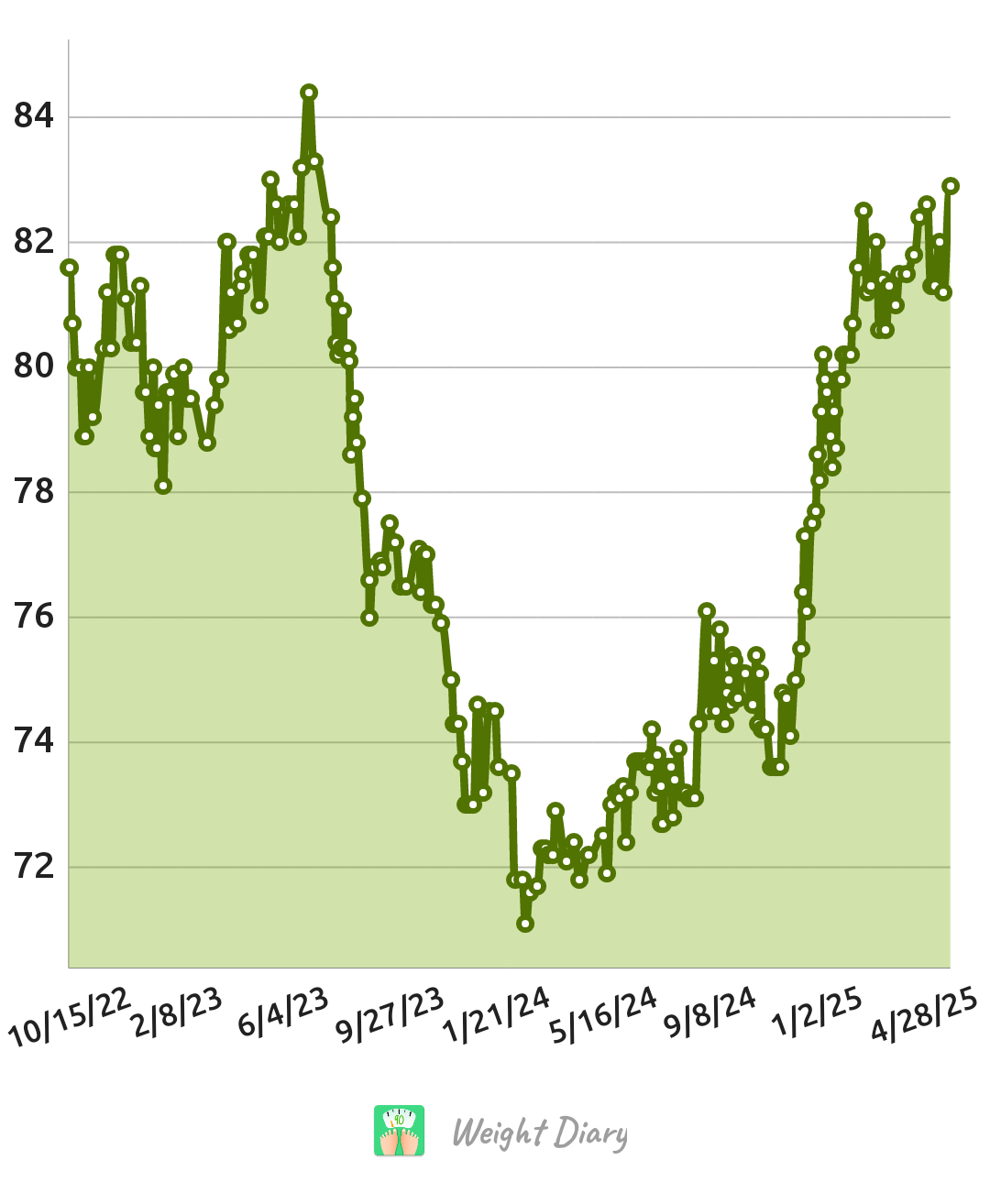
According to weight tracker app I maintained a normal weight from 17 August 2023 to 10 January 2025, that is for nearly 1 year and 5 months.


Generally, it was quite easy to follow my diet when I lived alone and my weight even reached 71 kg, and now at the moment of writing it is 82kg. The weight problem resurfaced when I moved with my parents as it became difficult to eat healthy due to many temptations.

In fact, they visit my brothers in Europe and always bring a lot of delicious but unhealthy foods. I resisted the temptation for 2 months than indulged myself into eating unhealthy food.

Besides, none my family members follows a diet, and sometimes when I encounter a warm and delicious food with a tempting aroma it is hard to resist for long.

What is my diet

My diet combines the teachings of Dr. Jean Seignalet and Pr. Henri Joyeux teaching, it is gluten-free, dairy-free, limited to specific type of meat and oil, cooked at low temperature, no GMOs and supplemented Omega 3, vitamins and minerals. It is an anti-cancer diet also called hypotoxic diet, or ancestral diet.

It is not an easy diet, as in its essence very strict but I trust my dietitian, and as I have followed this diet I lost weight and my psychiatrist reduced my medication dosage. Moreover, even my psychiatrist spoke to my dietitian who he explained to her the diet and its benefits for over an hour, she told me it is the best diet to follow.

How to get back to a Normal BMI

After analyzing the causes of my weight gain and having a BMI above 25, I come to the conclusion that there are key aspects that I can address on one by one starting from the most efficient solution, without falling into the trap of trying too much at once:

  • Eat slowly and savour the food
  • Consider the time and energy put to buy & prepare the meal so that I eat slower and eat with intention and chew calmly
  • Always start with salads and eat a generous amount of it before eating the main dish
  • Invest more time to cook and learn new recipes
  • Cook tasty food as I used to prioritize easy to prepare food, easy to store and not expensive
  • As in Islam, eat only when hungry
  • 1/3 food, 1/3 liquid and 1/3 empty stomach as taught in Islam
  • Keep exercising regularly
  • Put fruits and vegetables in my room at night before sleep so that I eat healthy food if I wake up in the middle of night
  • Limiting snacking
  • Working on managing stress and emotional eating

Does BMI matter that much

Even though, I am not obese but slightly overweight, research suggest that some obese people as classified by BMI do not display metabolic disease such as insulin resistance, high cholesterol and abnormal blood pressure. This condition is known as Metabolically Healthy Obesity (MHO).

Second, BMI measures, do not take into account muscle mass, and fat distribution.

Third, factors such as smoking, alcohol consumption, the food quality, and sleep have considerable impact on our health.


Finally, cardiorespiratory fitness (CRF) is a key health indicator that reduces our mortality risk regardless of our weight.

On the other hand, being overweight affects my self-confidence, puts extra strain on my back and knees. Having abdominal fat does not look particular good either, taking into account that I am striving to regain fitness and build muscle and become athletic again. Also a new study conducted on millions of people suggest that being overweight shortens people lives.

Knowledge is the Best Weapon

As I am aware of having the perfectionism and all or nothing cognitive biases, I am now better equipped to regain a normal weight. Having more awareness of these cognitive biases and scientific findings, I am more accepting that I can be overweight but healthy, especially that I do not smoke, or drink alcohol and I exercise regularly.

Meantime, I still need to work on managing anxiety and stress, learn healthier recipes and eat mindfully. In fact, when I succeeded in chewing slowly and savor every bite, I experienced joy, calm and a zen state of mind. This is particularly true, when I buy the groceries, clean them and cook them myself.

Conclusion

Cultivating self-compassion and avoiding perfectionism matters in my case, in fact being slightly overweight can be seen as a victory for people in my case, since I take Olanzapine a medication known to make patients feel more hungry and contribute to gaining weight. However, this won’t stop me from trying new tools and techniques to have a normal weight and be muscular. In short, I accept that is harder to reach that goal but it is doable and it’s fun to have a challenge like this.


How to Navigate Over-Identifying with Ones Diagnosis

Overidentifying with one diagnosis has a shrinking effect on our lives.

I have fallen into this trap for years and I was unaware of the meaning of overindentifying with ones diagnosis.

This led to numerous negative effects on my life:

Narrow my Identity

Before the 2006 relapse and complications which also led to injuries and chronic fatigue my fitness level changed dramatically and I could not practice sports and enjoy my hobbies. Part of my identity and self-worth collapsed and I saw that my illnesses, that took around a decade to understand and accept, as my new identity.

Increased Victim Mentality

I blamed the physicians and also my parents for the my health for years. However, as I kept educating myself, and I saw nothing positive coming from this blame even if there was some truth in it, I did what I could do with what I had at the moment and did my best to grow in my personal and professional life.

Avoidance of Growth Opportunities

Opportunity for healing and expansion like:

I rarely socialized or met new people—or even reconnected with old friends—despite knowing how valuable these connections could be. Expanding my professional and personal network opens doors to fresh ideas, collaborations, and potential clients, yet I still kept my interactions limited.

Challenging situations, such as trying a new sport which could be seen as risky or even dangerous but actually is not, as when I mustered courage around 11 months ago to try to use a bicycle again. It turned out it is a great idea to get back to fitness and have fun.

At that time, fear of getting hurt held me back, and I never even believed it was possible to use a bicycle to begin with.

Reduced Resilience

When someone thinks his illnesses define him, he adopts fixed mindset and not growth mindset. This belief reduces the chance of learning new coping skills to manage and improves one’s condition such as regular exercises, journaling, breathing techniques, eating healthy…

Resilience is generally built when facing discomfort in a safe and supported manner. We can generally accept the issues we are facing as temporary and adapt and grow from there. The main idea is to know that “yes we can” and “we do try”, thus succeeding becomes possible. Otherwise, if we are stuck in our negativity and we do not even try it is certain we won’t succeed.


Elon Musk says it in his own way:

The first step is to establish that something is possible; then probability will occur.

Stigma Internalization

This happen when someone absorbs negative societal beliefs about his own mental health disorders and turns them inwards. When amplified by overidentification will damage to the sufferer further.

To use a technical word adopting “limiting beliefs” is when someone thinks he is lesser than other people or is inherently flawed after internalizing societal messages.

Not accepting our mental disorder and feeling shameful because of it and censoring ourselves out of fear of judgment leads to isolation & worsen the symptoms.

As a matter of fact, I used to fixate on the symptoms of my disorders that lead to acting in a weirder way which can make it obvious that I have mental health issues, a self-fulfilling prophecy. For example sometimes, I say something and its opposite in the same sentence, omitting words from a sentence etc…, this may be due to many things such as:
– Racing thoughts, flight of ideas and pressured speech as I am bipolar

– Self-editing while speaking as I am still to some extent a perfectionist intrusive thoughts because of OCD.

I tended to judge myself as fundamentally broken rather than simply acknowledging I have some challenges to work through. This self-criticism just feeds my anxiety, which then leaves me both mentally and physically exhausted. The truth is, if I could recognize and accept my perfectionist tendencies, racing thoughts, self-editing, I’d be in a much better position to push back against them.


How to fight back all these negative aspects of overidentification:

Reframe our Language

To create a distance between myself and the disorder and to treat my disorder as a temporary state not as a fixed identity. For example I would say “I’m experiencing anxiety right now.” instead of “I am anxious.”
This will help create a mental space for a new perspective, self-compassion and change.

Focus on Strengths not Symptoms

Ask “What have I overcome, what am good at?”

It is a good ideas as well to print in a paper my skills, successes and accomplishments after the diagnosis.

A bullet list will do the job. You can put it somewhere you see everyday like next to your computer screen. Or create a reminder on your computer or smartphone where it will pop up every now & then so that you do not forget your successes and be aware that we are more than one’s diagnoses.


Reconnected with my Pre-Diagnosis Interests

As sport was an integral part of my identity before health complications, it was also a healthy and fun activity, I kept trying to rekindle this activity with generally one failure after the other. As I suffer from chronic fatigue, muscle contraction, and I could not implement a progressive approach to my training. Besides, I could not grasp how weak I have became.

However, as I am acquiring more tools and knowledge about my mental & physical conditions, I am visiting the orthopedist very rarely the last 3 years comparing to very frequent visits before. I am managing and improving my fitness better than before.

Being flexible and ready to take calculated risks, I have succeeded memorably in using a bicycle as the main mean of transportation for 11 months straight, also I use it as aerobic exercise and I sweated regularly using it even during the winter. In fact, I did not do aerobic exercises or sweated after physical activity for around 19 years.

As my cycling journey continues with a respectable degree of success I am gaining more confidence and rebuilding my identity as a fit and sporty man.

Another sport that I am revisiting is surfcasting, that is fishing from the shore using a fishing rod. As I live next to the beach and being a biophile this sport is relaxing and fun. As a naturally curious person and avid learner this activity nudges me to study marine life, the weather, fishing techniques and so forth.

Adopt Non-Mental Health Roles & Develop New Skills

As I am adopting non-mental health roles, I define myself by what I do and contribute to not the health issues I manage.

To reinforce growth mindset, I am learning computer science by having my own home server. Thus, I am learning Linux system administrator skills as well as coding skills. This is very fun and engaging. When I dive into it I forget about my health issues.

Moreover, I am studying software internationalization which may support career growth.

Furthermore, I contribute to open-source projects which enable me connect with new people that are interested with the same projects, learn new skills and give back to the community. Open-source contribution also boosts my professional portfolio.

Another skill that facilitates my growth and empowers my physical & mental health is cooking. I cook only healthy food and I enjoy going to the market to choose fresh produce. I watch YouTube video and read different articles to explore new recipes, get inspired.

Thus, I see myself as learner, a computer savvy, a cook, a cyclist, a angler, and blogger not the person who used to be overwhelmed with various ailments and mental health issue.

Of course forging a new identity requires courage, effort and time.


Balance Acceptance with Agency to Manage Overidentification

The forces of acceptance and agency seem opposite, however they work hand in hand to reclaim a sense of control over one’s mental health without falling into the trap of denial and resignation.

Below is what I did to strike balance to accept our conditions & shape our lives:

Acceptance: A Foundation for Clarity

I used to be shameful of having mental health issues, however, my bipolar disorder even though I am stable for around 20 years, has led to a significant damage to my life.
Not accepting my diagnosis results in further suffering, waste energy, and delays progress.

Acceptance signals the start of managing my mental disorders. It means acknowledging my diagnosis and impact without judgement. It’s saying “Right now, I have OCD, PTSDPTSD Post-Traumatic Stress Disorder, a mental health condition that can develop after someone experiences or witnesses a traumatic event. Key symptoms may include: Flashbacks or intrusive memories of the event, nightmares or disturbing thoughts, emotional distress or physical reactions to reminders of the trauma, avoidance of places, people, or activities that trigger memories of the event, difficulty sleeping or concentrating. and Bipolar disorder “ rather than “This is who I am forever”.

This reduces internal conflicts and negativity which gave me more space and energy for problem solving. This allows me to plan and adjust for them such as: doing Exposure & Response Prevention for OCD, planning a better sleep hygiene, plan for Bipolar Disorder cycles etc.

It is also important to practice radical acceptance and mindful observation of our conditions to reduce the intensity of overidentification. Even when suffering deeply we’d rather say: “I have OCD, and fighting that truth only deepens my suffering.” as well as mindfully noticing the symptoms with attaching negative labels to them: “My anxiety is high today” instead of “I’m failing because I’m anxious”.

Agency: Own your story, steer your mind

Agency is of utmost importance and we’d rather believe that we can influence our lives despite the constraints. I learned this from therapy and it took me around 4 therapy sessions to grasp it.
Thus despite my bipolar disorder, PTSD, OCD, back problem, chronic fatigue, joints issues and even more, I was able to avoid further damage first, then move forward with my life.


Put agency in action with value-based action, by aligning actions with what matters to oneself such as: “even if I am tired today, I will cook to myself a healthy meal and avoid junk food to nourish my mind and body with the best fuel possible aligning with my goals and self-respect.”

Besides, we can use micro-action as a way to practice agency, as an example even if I have tendinitis on my knee instead of cycling for 1 hour I will cycle for 10 minutes or just walk.

The Synergy of Acceptance and Agency

These forces are not opposite they are work hand in hand as partners. As an example, as a bipolar person I accept the susceptibility to manic episodes (acceptance) while creating a relapse-prevention plan (agency). I acknowledge the risk without letting it dictate my future.

How to Combine this Cohesively

  • Acknowledge the limitations: “My OCD makes socializing difficult”.
  • Choose a response: “I will attend the gathering for 30 minutes & I will use grounding techniques such as breathing exercises”.
  • Reflect & adjust: “I showed up, even if I left early. This is still progress. I may try to use other techniques and do more ERP for OCD”

Pitfall to Avoid

  • Over-Acceptance: Resigning to the diagnosis e.g., “I’ll never work again because of my anxiety”. Or “It is impossible to be fit again because of my tendinitis and back pain”.
    => Fix: Pair acceptance with curiosity: “What accommodations could help me thrive at work?”, or “Are there low impact sports I can do progressively to get back in a good shape”.
  • Toxic Positivity: Forcing agency without acknowledging the pain. This can be physical or mental pain, and pushing through the pain can make us suffer more and generally as a consequence we will need more time to recover as well. Such as: “Do not care about the your fear they are just mental.”
    =>Fix: Validate struggles first: “This is hard, and I’ll still try one small step.”

Conclusion

Living at the intersection of acceptance and agency means holding two truths simultaneously: yes, I have enduring conditions that require management, and yes, I am capable of reinvention. The orthopedist’s waiting room visits have decreased not because my body changed, but because my mindset did. Where I once saw a permanent damage I see it now as a puzzle to solve—adjusting cycling posture for tendonitis, modifying recipes for energy levels, psychoeducation to have more insights. This nuanced approach has yielded something unexpected: a life where bipolar disorder, OCD, chronic fatigue, and PTSD exist alongside coding projects, surfcasting adventures, cycling trips and the smell of fresh herbs sautéing in olive oil. Not cured, but certainly unbounded.

From Progress to Insight: Learning Through a Setback in My Cycling Journey

In my previous post on success cycling without an issue for one month, I am following up with a reflection a minor set back that taught me a lesson.

The set back

As I could bike for longer distances without taking a break and as I grew more confident. I did not stop cycling at bumpy road and was not as careful as I used to be. Previously, I would dismount and walk through bumpy roads to avoid straining my back. Recently, I stopped doing that anymore.

My Mistake: I thought about protecting my back but I forgot about my knees

When on those rough roads I stood on the paddles to reduce the impacts on my spine (as I have degenerative disk disease), however this shifted all the pressure and shocks on my knees.

As a result, I developed a knee pain. And even though I could still cycle, I’d better limit my use of the bicycle to recover fully before. As cycling worsens my knee pain.

I require new course correct

With every success comes new challenges, which themselves requires new solutions, and this does never end especially as a believer in continuous improvement, and we want to build the best version of your life.

The new course correct, is first I am resting until the knee pain subsides. But I won’t be entirely inactive. Staying gently active—like walking or light cycling—helps lubricate the joints and ease discomfort. When I say being gently active I mean doing basic walking or cycling without aggravating the pain.

In fact, if I stay at home and do not go out a three or four times a day out, I will end up more anxious, overly focused on my pains whether physical or mental, and also if I spend most of the time using the screen of the computer or smartphone it will land me at the eye doctor. This happened to me before and I entered a vicious circle that was not easy to break.

Building a diversified life


I will add that generally working on more than one project regularly, eases the impacts of setbacks, pain, or temporary failures. Multiples projects creates a sense of balance and promotes overall wellbeing. I often compare it to a building—our life’s structure is stronger when supported by many pillars. When life shakes up these pillars help us stay strong and we do not collapse.

As an example I do not only rely on cycling as a sport but I walk and do muscle strengthening with or without weights. As a result, of cycling pain, I can still fallback to other sports activities to stay active.

Besides, other activities then sports bring me joy such as cooking or searching for recipes that meet my needs. So finding a healthy recipes and exploring the possibilities of swapping one ingredient with another , or adding a new ingredient, or changing the cooking time or method is fun and rewarding.

Another main pillar in my life is reading, or if I want to avoid eye fatigue I listen to eBooks. Getting quality knowledge and information will for sure influence our thinking, feelings and behavior. When I have some physical limitations, in this case, and I can’t use the bicycle with freedom, I simply listen to more eBooks, podcasts, or using Pocket app I to listen to articles. First, I choose the subject I want to explore then I listen to it in the format I want, books, podcasts, or articles.

Another project, is exploring and enjoying nature. It can be in a form of sightseeing, enjoying the outdoors, studying marine life, studying fishing and different fishing techniques, and actually fishing and savoring fresh fish meal.


Investing in multiple projects can bring a lot of joy, alleviate anxiety and reduces stress. There are so many things we can do, we’d better invest our time in healthy and productive projects. Especially, knowing that when in pain we can easily fall into self-destructive behaviors


More importantly, when we use the power of habits and we keep nurturing these pillars we turn into fit person, great cook, educated person and so forth.

Being Strategic & Following a Plan

Maintaining objectivity and awareness of our strengths and weaknesses for sure support our recovery & equip us to better deal with the vicissitudes of life. I have noticed myself responding more gracefully when under pressure and also responding more strategically.

Honest self-reflection after setbacks is crucial for understanding my character, automatic behaviors and recurring patterns. I often experience excessive elation when I succeed at overcoming an obstacle leading me to believe I do not need to maintain caution. To counter this is to measure my sport activities and do gradual improvements, even when there is a breakthrough in well being.


The solution involves creating a structured plan, using a dedicated app to track workouts, maintaining consistency and embracing the long-term perspective by starting small and progressively building momentum.

Conclusion

Every setback carries its own lesson – this knee pain reminded me that progress requires balance, not just momentum. As I move forward, I’ll carry these insights: celebrating small wins without abandoning caution, diversifying my activities to build resilience, and trusting in gradual, sustainable growth. True wellbeing isn’t about any single victory, but about developing the wisdom to navigate life’s bumps without losing our way.